
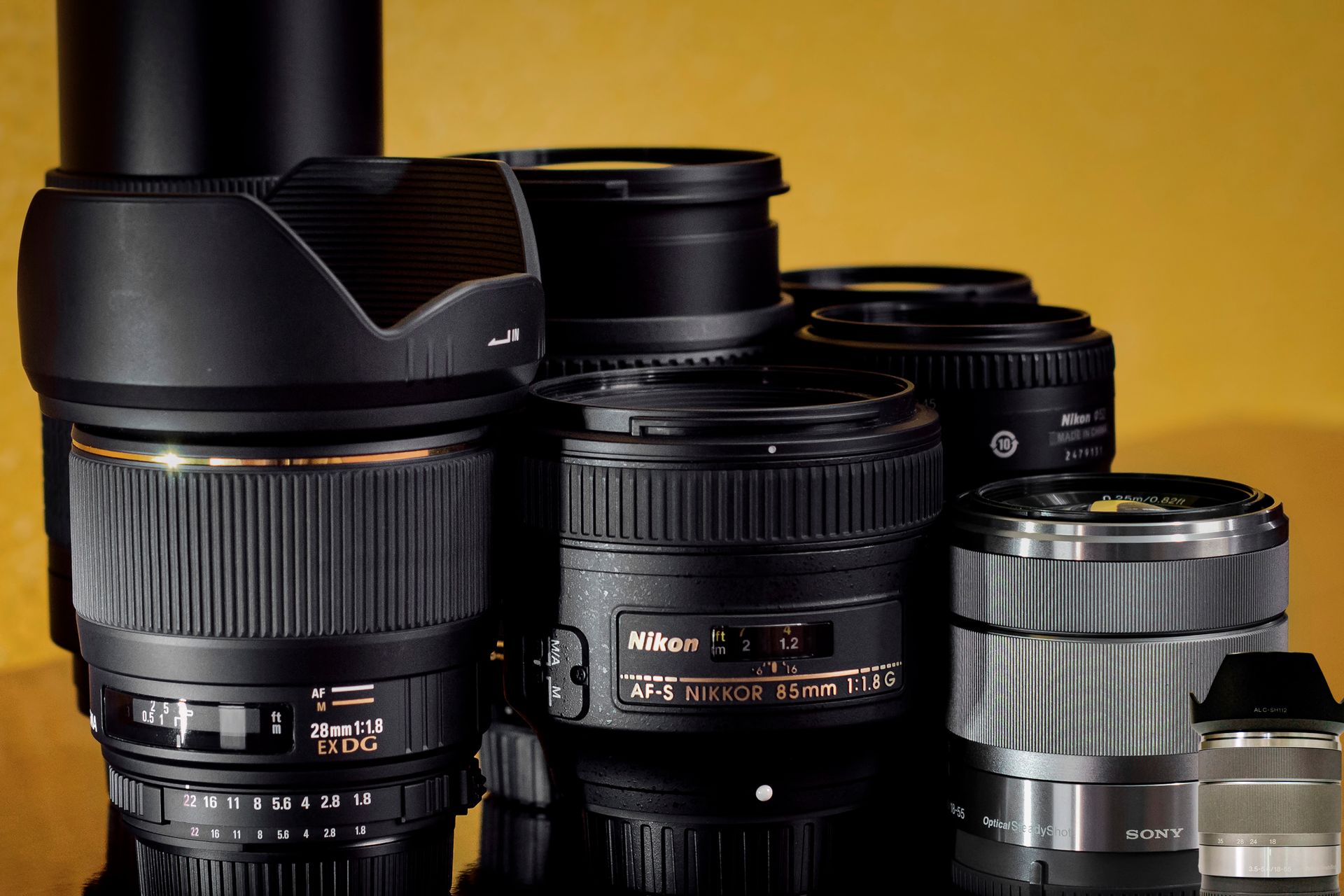
As a photographer, I have learned that the same face can be photographed four ways and look like four different people. Frame it the same way with a 24 mm, a 50 mm, an 85 mm and a 105 mm lens, and the face changes. At 24 mm the nose grows and the ears retreat; by 85 or 105 mm the features settle and flatten, which is why portrait photographers tend to reach for the longer lenses. (Technical not - the change comes from distance. A shorter lens has to stand closer to fill the frame, and closeness exaggerates whatever is nearest the camera.)
This may also explain why so many people dislike their selfies. A phone’s short lens, held at arm’s length, shows a face that differs from the one in the mirror. So which is the real face? Each is an honest picture taken from a particular standpoint, and none of them is the whole face. What we see depends on where the camera stands, and that is a thoroughly ToK observation.
A ToK prescribed title works the same way. It supports several reasonable readings, and your essay has to choose one and say why. This post shows how to interpret a ToK essay title and justify that choice, so your reader knows which lens you are using.
Why the choice matters
Examiners are asked, in effect, whether an essay offers a “clear, coherent and critical” exploration of the title. An interpretation is where clarity starts, and essays tend to miss it in one of two ways.
The first kind of essay that misses is the one that never chooses. It swaps lenses from paragraph to paragraph, answering a broad version of the title here and a narrow one there, and it usually ends with “it depends.” Each section may be sound; together they do not add up to an argument.
The second essay chooses silently. It has a reading, and it may even be a good one, but the reader is left to guess whether the reading was a decision or an accident. An unexplained reading can look a great deal like one of the quiet mutations we met when unpacking the title, even when it is nothing of the kind.
Both problems have the same remedy: pick one lens, and say why you chose that one.
How to interpret a ToK essay title: four steps
- List two or three plausible readings. Build them from the assumptions you found when you unpacked the title and the terms you defined in context. Each reading should be one sentence.
- Run the mutation check on each. Compare every reading with the original, word by word. Has anything been dropped, added, or softened? A reading that loses a word is a different title.
- Choose the reading with the most tension. Of the readings that survive, prefer the one your two areas of knowledge would answer differently. (This is the tension test again, applied to readings instead of titles.)
- Justify it, including what is outside the frame. In one or two sentences, say why this reading keeps the title intact, why it suits your areas of knowledge, and what it leaves out.
That last step is the one students most often skip, and it is the one that shows judgment. Naming what lies outside your frame tells the reader the choice was deliberate.
A reading you set aside need not be wasted, either. It can return later as a counterclaim or as another perspective on the title. In the essay itself, the interpretation usually takes two or three sentences, early on.
Worked example: interpreting a May 2024 prescribed title
Here is the past prescribed title this series has been following, with history as the second area of knowledge:
Are we too quick to assume that the most recent evidence is inevitably the strongest? Discuss with reference to the natural sciences and one other area of knowledge.
Three readings, through three lenses:
The wide angle: “Do people in general trust new evidence too readily?” This takes in everything, and the subject shrinks. “Inevitably” and “strongest” blur into the background, and “we” becomes everyone at once.
The telephoto: “Is recent evidence ever guaranteed to be the strongest?” This isolates “inevitably” so tightly that the answer is obviously no. It is a slack string, and the essay would be over in a paragraph.
The chosen reading: “Do researchers and the wider public accept recent evidence as the strongest before it has been properly tested, and is the haste or the assumption at fault?” Every word of the title stays in the frame, and the reading uses the definitions from the last post: replication in the natural sciences, provenance and corroboration in history.
The two rejected readings still have their uses. The wide angle makes a reasonable establishing shot: a sentence or two in the introduction on why recent evidence is so often trusted. The telephoto’s close-up on “inevitably” can become a single sharp point inside the essay, where it shows the reader you noticed the title’s strongest word. Neither one can carry the whole essay, and that is the reason for choosing the third.
What justifying sounds like
A weaker justification:
I chose this interpretation because I find it the most interesting, and it lets me write about science.
A stronger one:
I read the title as asking whether knowers accept recent evidence as the strongest before it has been tested, and whether the haste or the assumption is at fault. I take “we” to include both researchers and the wider public, since the natural sciences build in time for replication that public discussion often skips, and a newly opened historical source can be celebrated before it is corroborated. This reading says less about how individual experts weigh competing studies, which I will return to as a counterclaim.
The weaker version justifies the reading by the student’s preference, which tells us about the student and little about the title. The stronger version justifies the reading by what it keeps in view: every word of the title, both areas of knowledge, and the definitions already set. It also names what lies outside the frame, which is the clearest sign of a deliberate choice.
Common traps
- Never choosing a lens. The essay drifts between readings and lands on “it depends.”
- The fisheye. A reading that bends the title until the answer becomes easy. (It is a close cousin of defining a term so the argument wins itself, from the last post.)
- Changing lenses halfway through.
- Justifying by preference. “It interests me” explains why you chose the title. A reading needs reasons drawn from the title itself.
- Spending too long on interpretation. With 1,600 words available, two or three sentences usually do the job.
Try it: frame your title
- Write three readings of your title, one sentence each.
- Run the mutation check on each.
- Choose the reading your two areas of knowledge would answer most differently.
- Write two sentences of justification. Begin the second with “This reading leaves out…”
- Take both sentences to your next conversation with your teacher.
Before the shutter clicks
Next in this series: Getting the Most from Your Three Teacher Interactions.
We trust a portrait more when the photographer can tell us why they stood where they did. The same goes for an essay. Choose your lens, say why, and name what lies outside the frame, and the reader can judge your picture on its own terms. (The mirror, meanwhile, can keep its opinions to itself.)
At The ToK Café, we choose our frame on purpose.