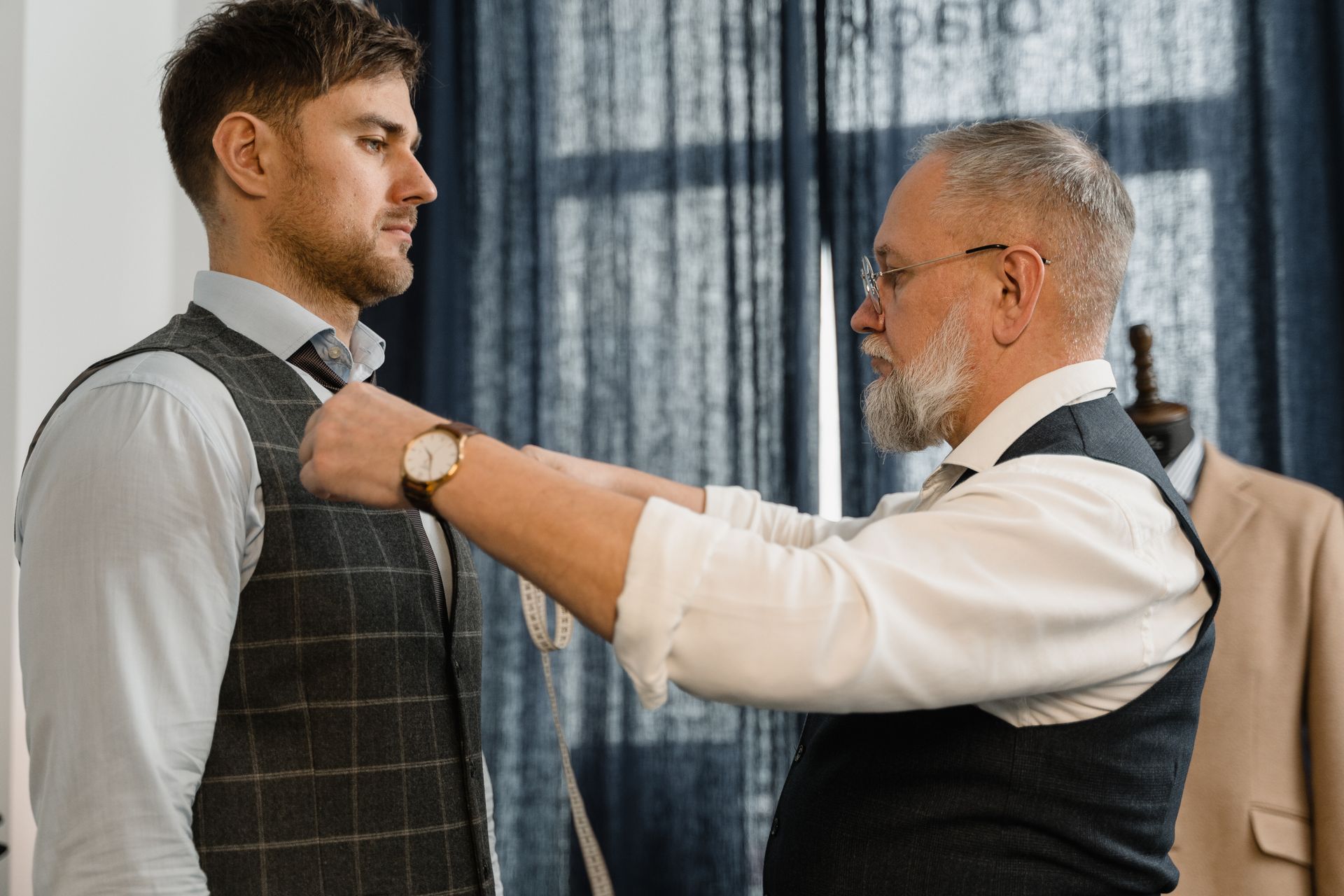
A bespoke suit takes more than one sitting. Traditionally it takes shape over a series of fittings, often three. At the first, the client tries on a loosely tacked “baste” garment, held together with long white stitches, so the cutter can check the basic shape. At the next, the shape is set and the details begin. At the last, only small refinements remain.
At each fitting, the cutter’s main tool is a flat piece of chalk. They mark where the shoulder pulls, where a sleeve sits long, where the back needs easing. The sewing happens afterwards, in the workshop. The client’s job is simpler, though easy to get wrong: turn up, wear the right shoes, and say plainly where it pinches. (A client who arrives in running shoes for a suit meant for dress shoes will get a beautifully hemmed pair of trousers that fits nothing they own.)
The ToK essay comes with its own set of fittings: three formal interactions with your teacher. This post looks at how to use your ToK teacher interactions well, so that each one has something on the stand worth marking.
Why the fittings matter
Three conversations is not many, spread across the five months or so between choosing a title and submitting the essay. Each one used without preparation is a fitting that cannot be repeated.
The first interaction matters most, because it sets the shape everything else is cut from. A student who arrives at it with a topic and a hopeful expression gives the teacher very little to mark. “I’m thinking about the science title” is a bolt of cloth on a shelf. The teacher can admire it, perhaps suggest a colour, but cannot tell you where it will pull.
The remedy is the same for all three: bring something to fit.
How to use your ToK teacher interactions: three fittings
The interactions are recorded on your planning and progress form, which goes in with the essay, so it helps to know what each one is for before you book it.
- The baste fitting (first interaction). Bring the shape of your argument, loosely tacked together. If you have followed this series, you already have the pieces: the title you chose with the tension test, the small words you circled when you unpacked it, your key terms defined for each area of knowledge, and your justified interpretation. Ask whether the shape will hold.
- The forward fitting (second interaction). Bring a full draft, even an untidy one. This is the moment to ask where the argument pulls: where it drifts from the title, where a counterclaim gives way too easily, where your two areas of knowledge stop talking to each other. Your teacher can comment on a draft but cannot rewrite it, so expect chalk marks.
- The finish fitting (third interaction). Bring the revised essay and your own judgment of it. By now the adjustments should be small: a definition tightened, a conclusion that adds an insight. Use the conversation to reflect on how your thinking changed along the way.
After each fitting, write down what was said, in your own words, the same day. Chalk rubs off quickly, and so does memory.
Worked example: preparing for the first interaction
Here is the past prescribed title this series has been following, with history as the second area of knowledge:
Are we too quick to assume that the most recent evidence is inevitably the strongest? Discuss with reference to the natural sciences and one other area of knowledge.
A student who has worked through the last four posts could bring a single page like this:
| Item | What it says |
|---|---|
| Tension | Newer evidence often benefits from better tools, but it has had the least time to be tested. |
| Small words | ”too quick,” “assume,” “inevitably,” “strongest,” “we” |
| Key terms | Strongest: replication in the natural sciences; provenance and corroboration in history. Recent: date of the evidence, or date it reached us? |
| Interpretation | Do researchers and the public accept recent evidence as strongest before it has been properly tested, and is the haste or the assumption at fault? |
| Outside the frame | How individual experts weigh competing studies (saved as a counterclaim) |
That page is the baste garment. Now compare two ways of opening the conversation.
What the questions sound like
Weaker questions:
Is my idea good? What should I write about?
Stronger questions:
My reading leaves out how experts weigh competing studies. Is that a reasonable exclusion for this title, or will the essay feel incomplete without it?
In history, I’m defining strong evidence mainly by provenance. Am I relying on that too heavily?
The weaker questions hand the teacher a bolt of cloth and ask them to design the suit. The stronger ones point to a specific seam and ask whether it holds. They show the teacher exactly where to put the chalk, and the answers will be far more useful. They also leave the decisions, and the sewing, with the student, which is where both belong.
Common traps
- Arriving with a topic and no garment. A title and a hope give your teacher almost nothing to mark.
- Asking the tailor to sew. Your teacher can question and comment; the rewriting is yours.
- Waiting for a perfect draft. A draft held back until it feels finished arrives too late to change. Bring the forward fitting forward.
- Forgetting the chalk. Feedback you didn’t write down tends to vanish within a week.
- Treating the form as paperwork. The record of your interactions is a record of your thinking. Notes written carefully now make the final reflection much easier.
Try it: pack your fitting kit
- On one page, write your title’s central tension in a single sentence.
- List the small words you circled.
- Define your two or three key terms for each area of knowledge.
- Add your interpretation and one line on what it leaves out.
- Finish with two questions, each pointing at a specific seam.
When the page is full, book your first interaction.
Before you leave the fitting room
This post closes the “Starting with the Title” series. Next week, a new question: Are You Writing a ToK Essay or a History Essay?
A well-made suit looks effortless, which hides the fittings behind it: three appointments, a great deal of chalk, and a client who arrived each time with something to try on. A strong ToK essay tends to have the same quiet history. Bring the garment, point to the seams, and do the sewing yourself. (The running shoes can stay at home.)
At The ToK Café, we bring something to fit.